Preprint 2026
Scalable Inference-time Steering in Biological Design with Multimodal Meta Flow Maps
1Harvard University 2Princeton University 3Kempner Institute 4IAIFI *Equal contribution
Overview
Biological design problems can be continuous (e.g. molecular structures), discrete (e.g. DNA residue types), or both (e.g. protein structure–sequence co-design). Diffusion and CTMC-based methods have been developed for multimodal generation, but it remains challenging to adapt them at inference time to fulfill design constraints.
Meta Flow Maps (MFM) are one-step posterior samplers. They have shown high controllability for image generation because they give accurate estimates of reward gradients. We develop the framework of discrete (dMFM) and multimodal (multiMFM) Meta Flow Map adaptable to biological domains. We use dMFM to design DNA sequences with a target mechanical property, and multiMFM trained on QM9 and GEOM-Drugs to design molecules with a given physical property and structural fingerprint. In both cases, steering improves target attainment using one reward-independent MFM per base generator.
Motivation
Molecular and sequence design tasks often require optimizing different combinations of objectives, such as stability, binding affinity, activity, or constraint satisfaction. Training or fine-tuning a separate generative model for every new reward limits the rate of experimentation. Instead, we keep a base generator fixed and steer it with reward-guided inference, so that different objectives can be explored without retraining the generator.
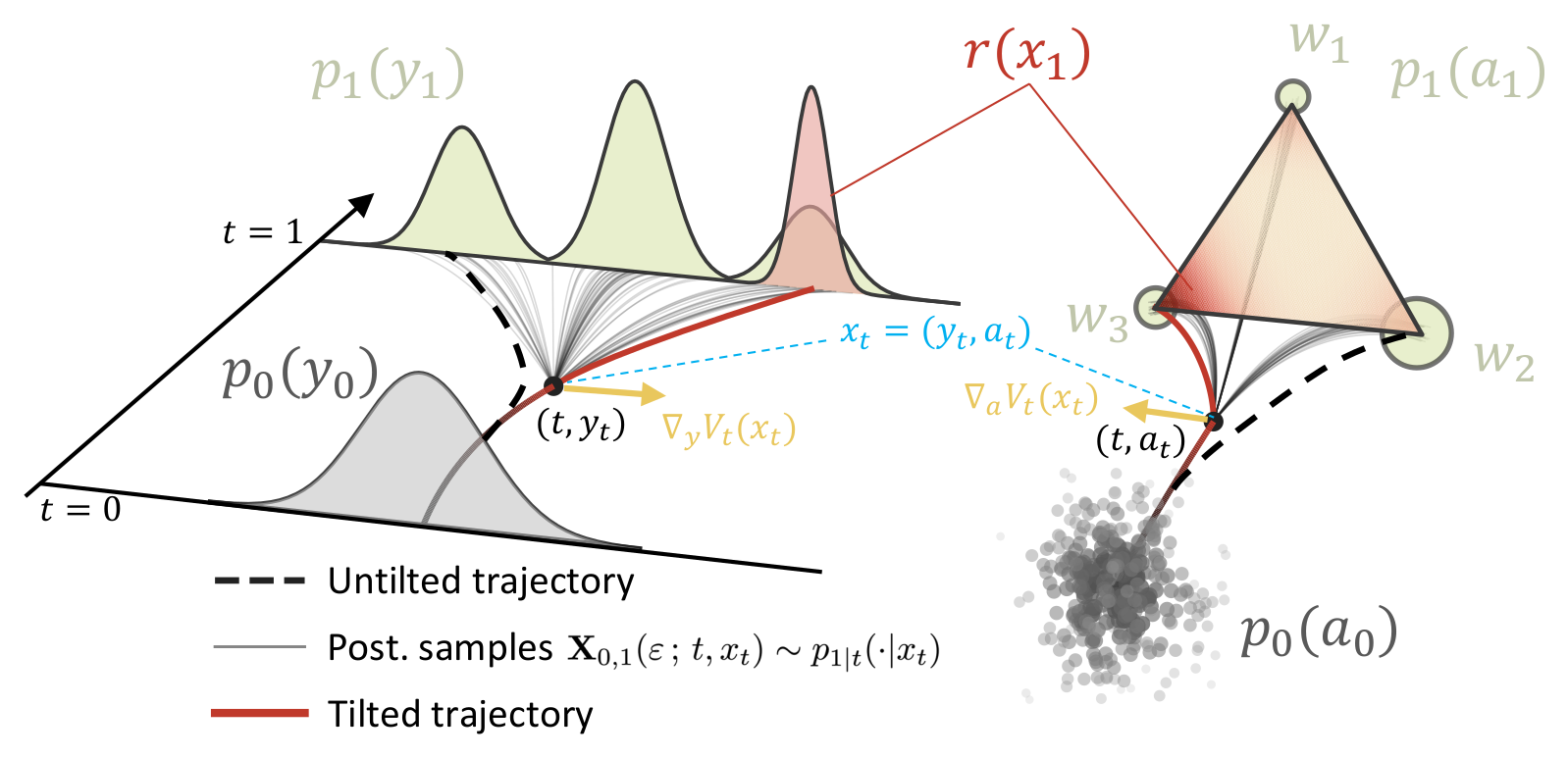
Reward-guided sampling needs the gradient of the value function \(V_t(x_t) = \log \mathbb{E}\big[e^{r(X_1)} \mid X_t = x_t\big]\), which is an expectation over the posterior of clean samples given the current state. Methods such as DPS evaluate the reward at a single denoised estimate instead. This is biased, and the bias does not go away with more compute. A Meta Flow Map gives cheap samples from the posterior, so the expectation can be estimated directly.
Our main contributions are:
- We formulate discrete GLASS posterior sampling and derive the discrete MFM.
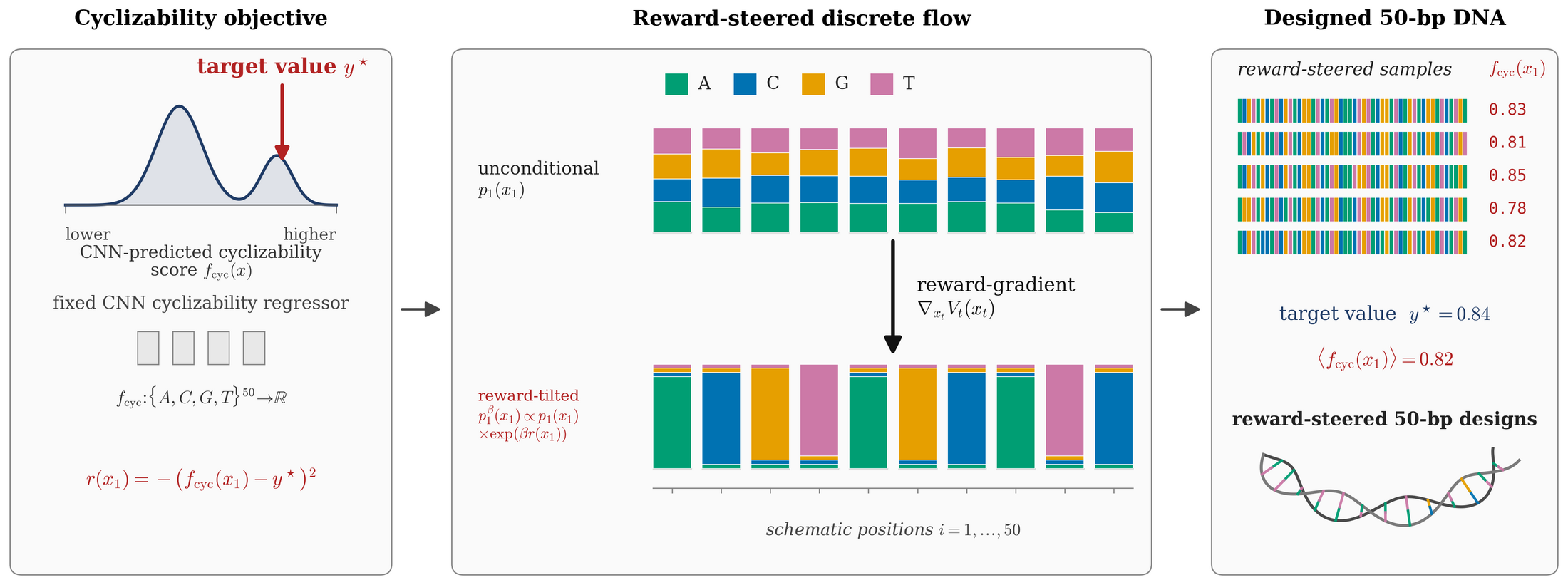
- dMFM optimizes generated DNA sequences at inference time toward prescribed predicted cyclizability values.
- We combine continuous and discrete MFMs into multiMFM for mixed discrete–continuous steering.
- We adopt multiMFM for small-molecule generation. multiMFM steers toward chemical-property targets with high accuracy, using a single distilled MFM that is reused across property objectives.
Method
A Meta Flow Map \(\Phi(\epsilon; t, x_t)\) sends Gaussian noise \(\epsilon\) to a sample of the posterior \(p_{1|t}(\cdot \mid x_t)\) in one step. Drawing \(N\) noises \(\epsilon_i\) and evaluating the map on each gives \(N\) posterior samples, and from the \(N\) samples we form a Monte Carlo estimate of the value-function gradient:
The MFM is distilled once from the base model and does not depend on the reward. For discrete data, we extend GLASS to sample \(p(x_1 \mid X_t = x_t)\) with an inner flow on the probability simplex. We then distill this inner flow into a dMFM, trained with a cross-entropy diagonal loss against the base denoiser plus a consistency loss. When the state has a continuous part \(y_t\) and a discrete part \(a_t\), multiMFM samples both jointly from \(p_{1|t}(y_1, a_1 \mid y_t, a_t)\). Each modality is then steered with its partial gradient of the same value function.
A toy example
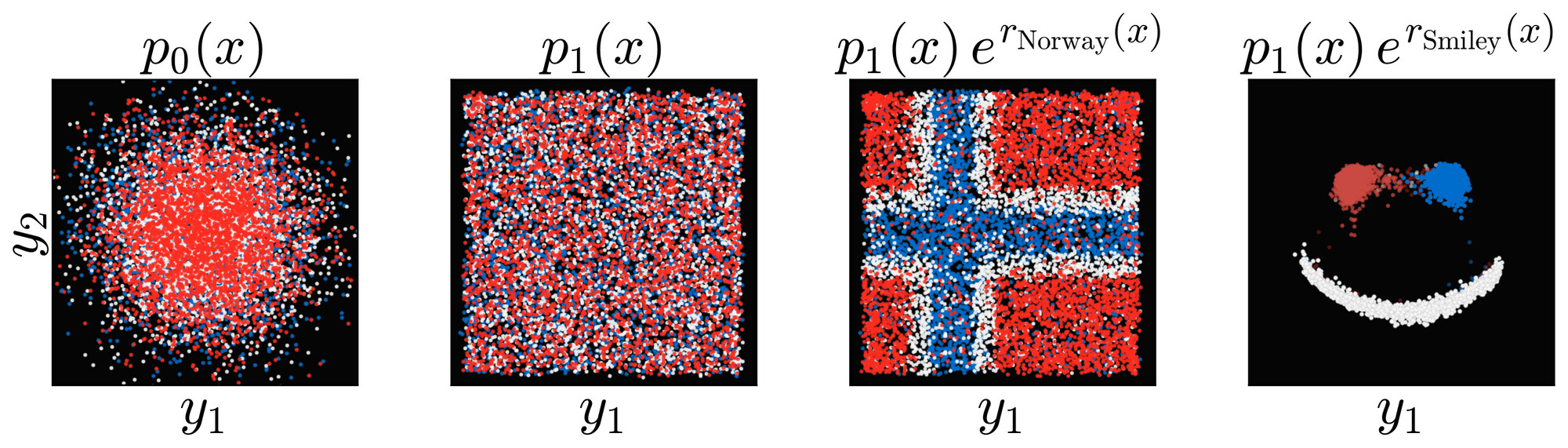
We also give a synthetic example. Each particle in the plane has a position and one of three colors, and the base model spreads the colors uniformly over a square. We steer the particles into a Norway flag or a smiley.
Results
- QM9, six properties 5 of 6 properties with the lowest MAE among steering methods, using one reward-independent backbone.
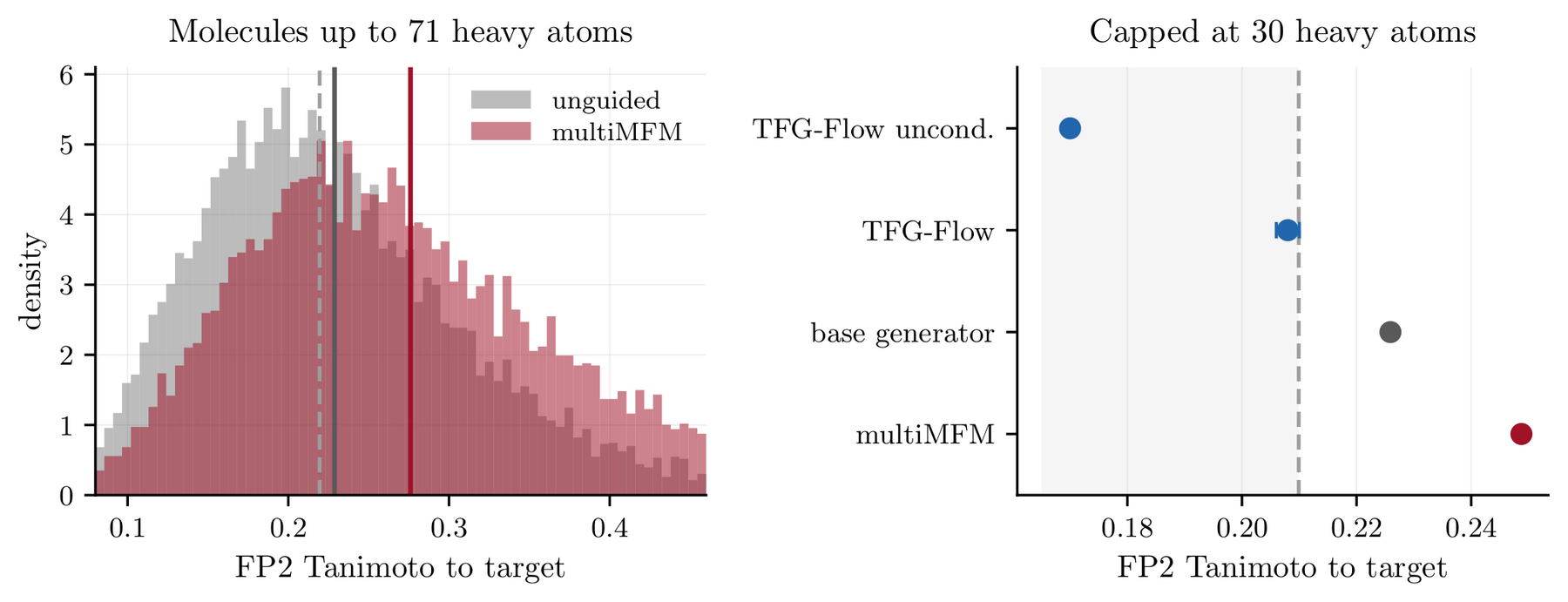
- GEOM-Drugs, Tanimoto 0.276 from 0.229 mean similarity to the target fingerprint, counted directly from the generated molecules.
- DNA, oracle MAE 0.15 from 1.17 at target cyclizability +1, scored by an oracle trained on disjoint parent sequences.
Molecular property guidance
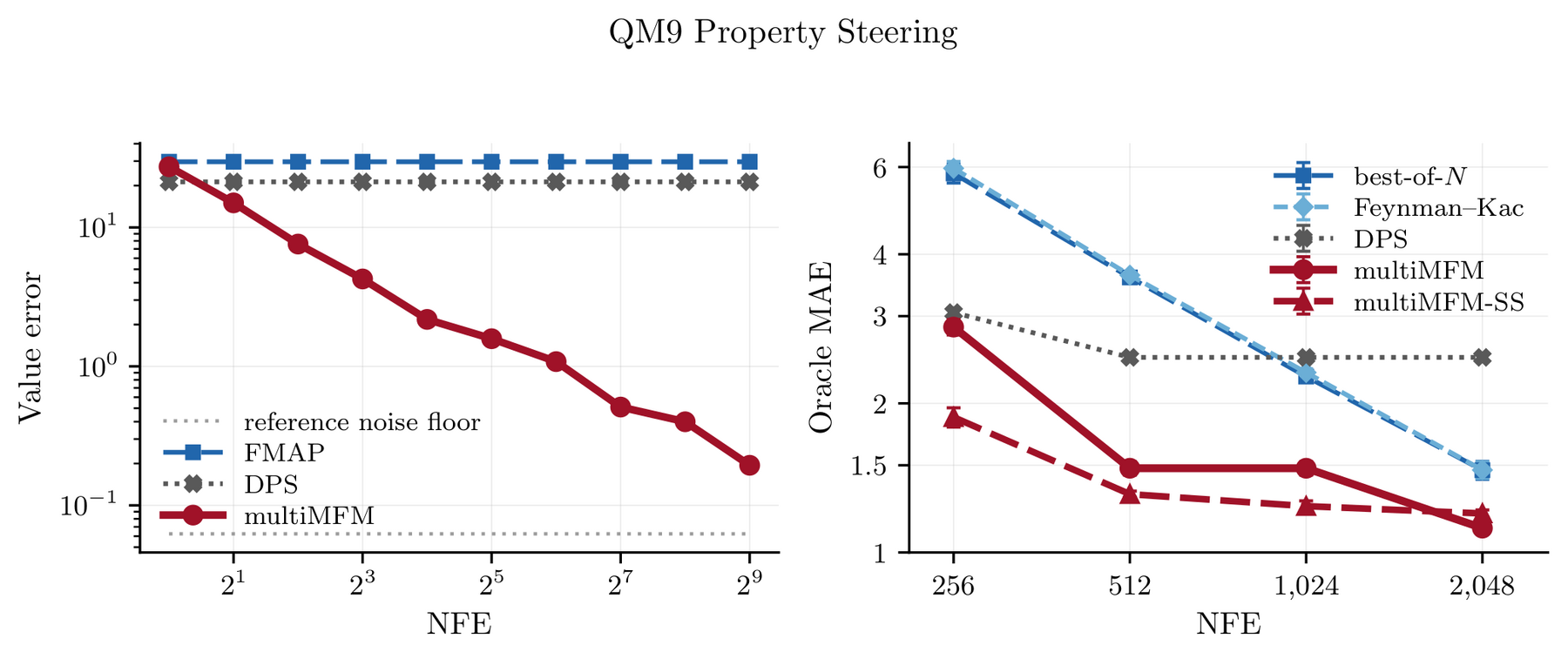
For molecules, the discrete modality is atom types and the continuous modality is coordinates. Our base model is inspired by Tabasco, with the CTMC for atom types replaced by discrete flow matching from a Gaussian prior to the simplex. We model heavy atoms only and use the property-guidance setup of TFG-Flow. multiMFM has lower error than the published TFG-Flow values on every property, and the lowest error among all inference-time methods on five of the six properties. The baseline numbers were evaluated with RDKit validity, while ours use the stricter PoseBusters filter, which also checks bond lengths, angles, planarity, clashes and internal energy.
One can add the steer-search trick (multiMFM-SS) to multiMFM. At every guided step multiMFM already computes look-ahead estimates of the finished molecule. Steer-search keeps the best PoseBusters-valid look-ahead according to the guide, and returns it instead of the trajectory's endpoint. This costs no additional generative-model evaluations, lowers the error on four of the six properties, and raises PoseBusters validity from 90.2–92.5% to 96.2–98.5%.
| Method | \(C_v\) | \(\mu\) | \(\alpha\) | \(\Delta\varepsilon\) | \(\varepsilon_{\mathrm{HOMO}}\) | \(\varepsilon_{\mathrm{LUMO}}\) |
|---|---|---|---|---|---|---|
| #Atoms (reference) | 1.97 | 1.05 | 3.86 | 886 | 426 | 813 |
| EEGSDE | 0.941 | 0.777 | 2.50 | 487 | 302 | 447 |
| UniGEM | 0.873 | 0.805 | 2.22 | 511 | 233 | 592 |
| TFG-Flow | 1.75 | 0.817 | 2.32 | 804 | 364 | 941 |
| multiMFM | 0.44 | 0.56 | 1.05 | 465 | 238 | 306 |
| multiMFM-SS | 0.43 | 0.56 | 0.99 | 450 | 238 | 274 |
QM9 mean absolute error (lower is better; energies in meV). Baseline values are reproduced from Table 1 of TFG-Flow. Our rows are means over replicate runs of 1,000 molecules each. The full table, with all baselines and PoseBusters validity, is in the paper.
Comparison at matched inference cost
On QM9 we compare against three inference-time methods that share our base generator, guide and held-out oracle: best-of-\(N\), Feynman–Kac steering, and DPS. Cost is counted in forward-equivalent network calls, and our backward pass is billed at its measured cost. The MFM estimates the value function from Monte Carlo samples, while the denoiser in DPS can only approximate it with a large bias. multiMFM is below every baseline at every budget, and its lead over DPS grows with the budget. multiMFM-SS reaches a given accuracy with about half the compute of best-of-\(N\).
Drug-sized molecules (GEOM-Drugs)
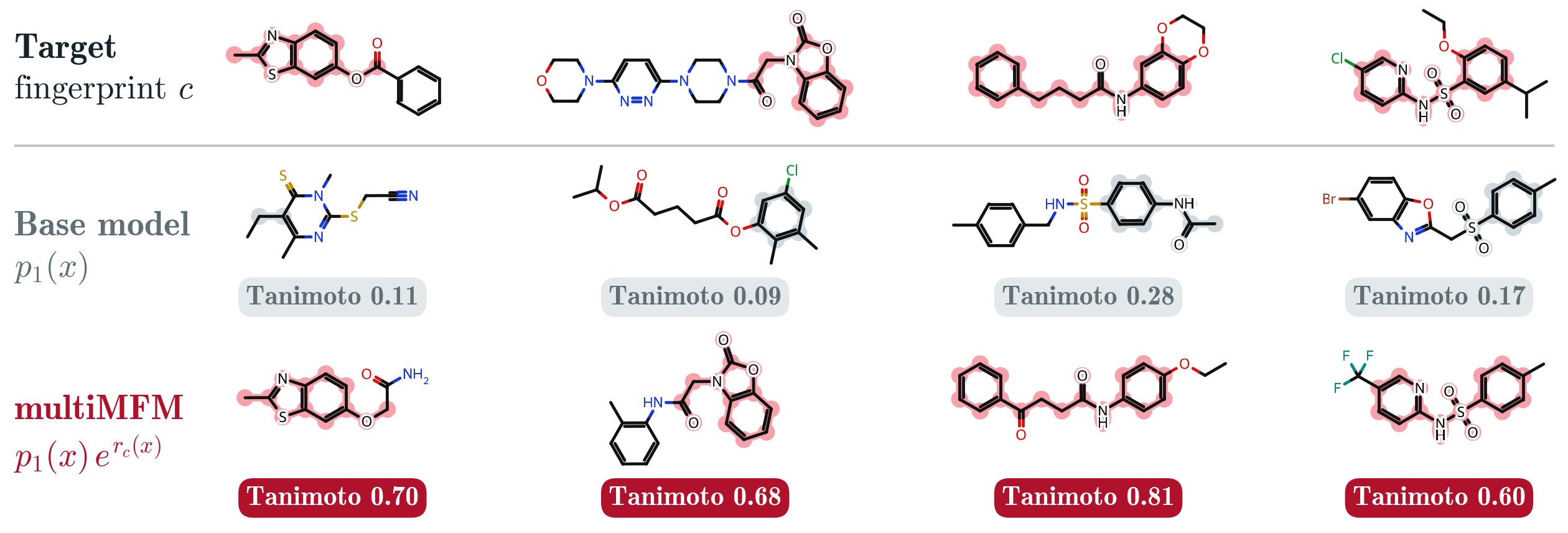
multiMFM scales to GEOM-Drugs molecules with up to 71 heavy atoms, compared with nine in QM9. Given a target fingerprint, we guide with a differentiable relaxation of the Tanimoto coefficient (TFG-Flow uses a squared error on the same fingerprints). For evaluation we count the fingerprints directly from the generated molecules, so no learned evaluator is involved. Four examples are shown at the top of this page.
Mean Tanimoto similarity should be read against a floor: two unrelated real molecules already share a similarity of about 0.22. Guidance raises the mean from 0.229 to 0.276 and increases the margin above the floor sixfold, while PoseBusters validity goes from 87.5% to 89.5%. Under TFG-Flow's 30-heavy-atom cap and scoring convention, multiMFM reaches 0.249, compared with TFG-Flow's published 0.208. TFG-Flow's tanimoto similarity is below the setting's floor of 0.210. Each result is averaged over three runs of 4,096 molecules.
DNA designed for a target mechanical property
Sequence-encoded DNA mechanics can carry regulatory information beyond transcription-factor motif content. Intrinsic cyclizability, a proxy for DNA bendability, is sequence dependent, and promoter-proximal yeast nucleosome-depleted regions contain unusually low-cyclizability DNA (Basu et al., 2021). We train a base discrete flow model on DNA, distill it into a dMFM, and steer 50-bp sequences toward a target predicted cyclizability.
To keep guidance and evaluation separate and to prevent reward hacking, we train two cyclizability regressors on disjoint parent sequences: a guide, which is differentiated only during sampling, and an oracle, which is used only for evaluation. For each target we generate 1,000 guided–unguided pairs from the same initial noise. Guidance reduces oracle MAE from 1.174 to 0.153 at \(y^\star{=}{+}1\) and from 0.833 to 0.117 at \(y^\star{=}{-}1\).
| Target \(y^\star\) | Mean oracle score | Oracle MAE ↓ | ||
|---|---|---|---|---|
| Unguided | Guided | Unguided | Guided | |
| \(+1\) | −0.171 | 0.920 | 1.174 | 0.153 |
| \(-1\) | −0.171 | −0.964 | 0.833 | 0.117 |
Cyclizability of 50-bp sequences guided with dMFM, scored by the oracle. 1,000 guided–unguided pairs per target, with shared initial noise. The oracle is trained on parent sequences disjoint from the guide's and is never used during sampling. 95% confidence half-widths are at most 0.026.
We also test rewards whose target error can be computed exactly, without an oracle: a motif (TTTTTC) and a conjunction of two motifs (TTTTTC and AAAATT). With the same guidance hyperparameters for sequences of 50 to 400 bases, guidance improves 93–98% of matched pairs and preserves both sample uniqueness and Evo2 likelihood.
Citation
@misc{unneberg2026multimfm,
  title  = {Scalable Inference-time Steering in Biological Design
            with Multimodal Meta Flow Maps},
  author = {Unneberg, Ulrik and Wang, Shiyi and Franceschi, Dinko
            and Xiong, Ziyu and Kozinsky, Boris and Zhong, Ellen D.
            and Albergo, Michael S.},
  year   = {2026},
  note   = {Preprint}
}